

How to use AI to design a medal that can actually be manufactured
A striking AI image is not a production drawing. Here is how to describe your idea so it can become a real medal faster and with fewer compromises.
A few sentences and one click can produce an impressive medal concept. But AI creates an image, not production documentation: it does not reliably check line width, text legibility, tooling requirements or whether small details will survive in real metal.
This guide helps you give AI instructions that are closer to manufacturing reality. You can reduce repeated revisions and improve the chances of receiving the medal you genuinely had in mind.
Beautiful on screen. Impossible in production.
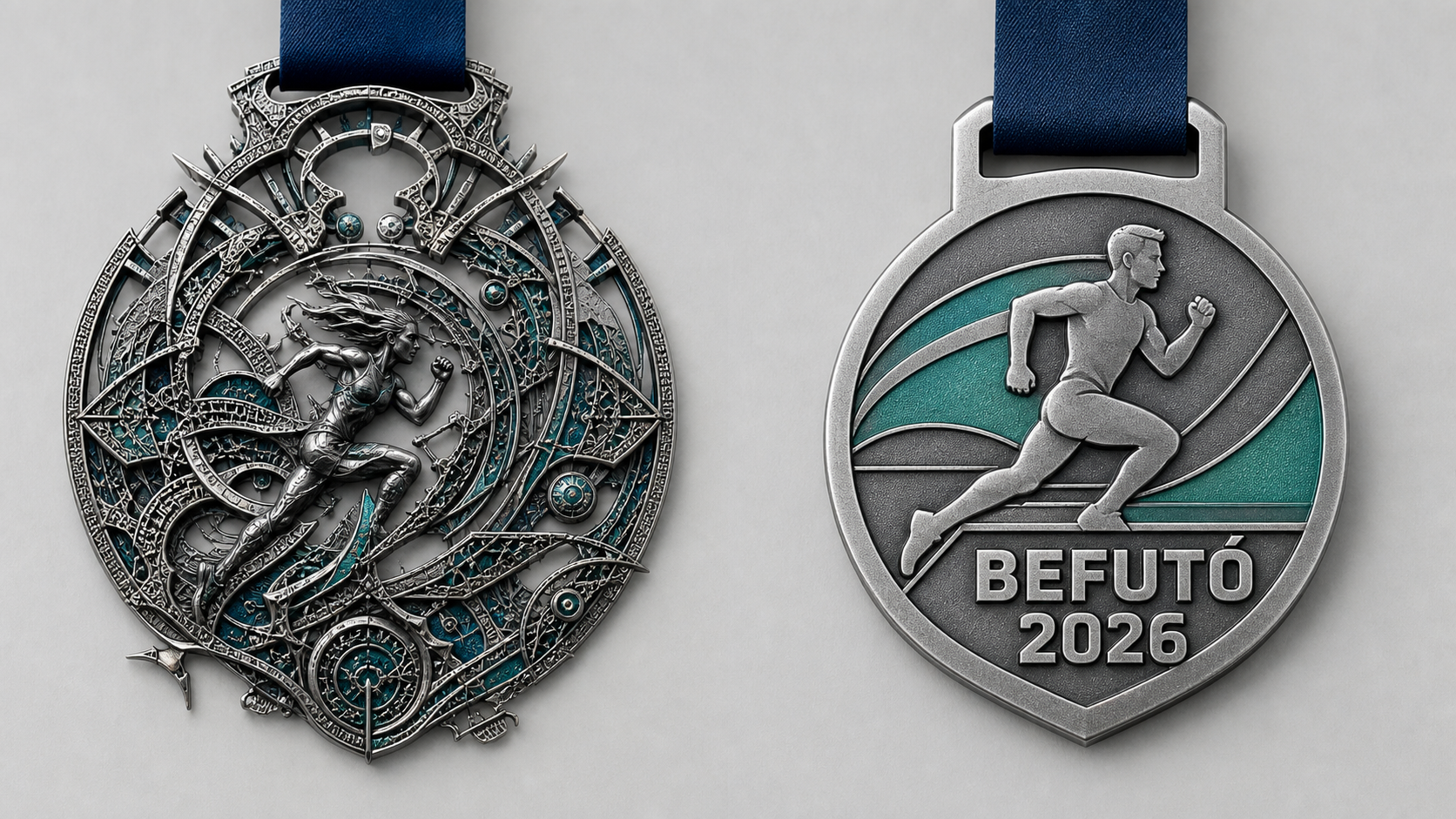
AI aims to produce a compelling image. It does not know with certainty which technology, size or material will be used. Generated concepts therefore often contain details that cannot be made in metal without substantial redesign.
Details that are too thin
Fine lines, narrow bridges and tiny projecting parts may disappear, blur or become fragile during production.
Photographic shading
Lighting, reflections, transparency and gradients may look convincing in a render but cannot be reproduced in the same way with raised and recessed metal surfaces.
Illegible lettering
AI often draws incorrect characters or text that becomes unreadable at the medal’s actual size.
Impossible geometry
Merged planes, negative angles, floating elements and deceptive perspective may have no manufacturable surface structure.
Relief and 3D areas cannot be painted
Sculpted, relief and 3D surfaces cannot be colour-filled with paint. Colour can be applied safely only inside flat, recessed and fully enclosed cells. Raised motifs get their appearance from the metal finish, relief and light—not paint.
Define the constraints before the creative idea
The more physical parameters AI knows, the less likely it is to treat the task as a simple illustration. Exact values depend on the quotation and chosen technology, but these points already make a major difference:
| Parameter | What should you specify? | Why does it matter? |
|---|---|---|
| Size and shape | For example, a 70 mm round medal or a custom outline | Determines the actual scale of details and lettering. |
| Material and finish | Metal medal, gold/silver/antique effect, coloured areas | Contrast behaves differently on antique and polished surfaces. |
| Relief | Flat and graphic or strongly sculpted appearance | Separates raised and recessed areas. |
| Colour filling | Plan colour as flat, recessed, fully enclosed cells | Relief and 3D areas cannot be painted; their effect comes from metal and depth. |
| Lettering | Exact wording, spelling and placement | AI frequently draws letters incorrectly. |
| Ribbon attachment | Top loop, concealed attachment or integrated feature | The ribbon attachment must physically connect to the medal. |
The six layers of an effective AI prompt
Physical object
State that this is a real metal medal and specify its size, shape and desired finish.
Production logic
Request clean contours, distinct raised and recessed planes and sturdy connections.
Subject and symbols
Do not merely say “running medal”. Define the main motif, background and wording.
Style and character
Minimalist, classical, modern, playful or bold? You may provide references, but do not request a copy.
Technical view
Request a straight-on, top-down design without perspective distortion or dramatic lighting.
Explicit exclusions
Specify no photographic effects, blur, hair-thin parts, illegible text, floating pieces or paint on 3D relief.
Copyable prompt example
“Design a genuinely manufacturable custom metal finisher medal, 70 mm in diameter. Show it straight on, from above, without perspective or dramatic lighting. The main motif is a runner in side view, with a simple finish-line gate behind them. Place the clearly legible text ‘FINISHER 2026’ in large capitals along the lower curve. Use a modern, bold and clean style with clearly separated raised and recessed metal surfaces. All connections must be sturdy and the ribbon attachment must physically connect to the medal body. Use painted colour only in flat, recessed and fully enclosed cells. Do not use gradients, photographic shading, blurred or hair-thin details, floating elements, tiny text or paint on sculpted 3D relief.”
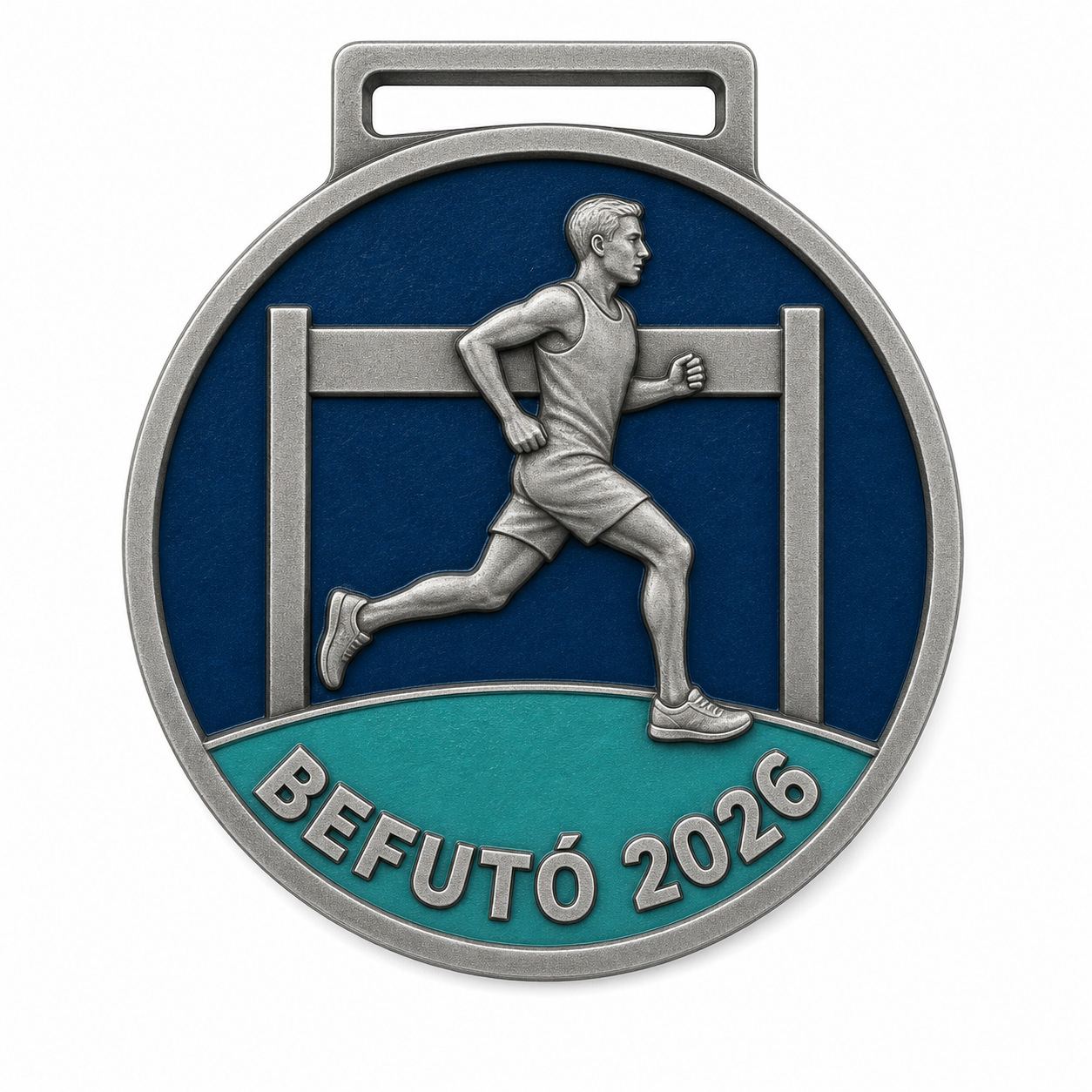
Result of the promptAI produced a clearer concept that can be understood from the front: large lettering, stable suspension, connected motifs and clearly separated metal and coloured areas. It is still not a production file, but it is a far better starting point for technical preparation.
Check these eight points before submitting your design
- Are all mandatory motifs present?
- Is the wording correct, correctly spelled and large enough?
- Do the main shapes have clean, unambiguous contours?
- Are there no floating or hair-thin connected elements?
- Can the design be understood from the front, not only as a perspective render?
- Can you distinguish raised, recessed, coloured and bare-metal areas?
- Are painted colours limited to flat, recessed and fully enclosed cells—not relief or 3D areas?
- Is this genuinely the composition you want on the finished medal?
We do not create “something similar” from your AI design
If you send an AI-generated design, we treat it as the approved creative direction. We do not independently reinterpret it, creatively transform it or replace it with a completely different composition. We return what we received, adjusted as necessary to make it manufacturable.
This may involve strengthening thin lines, resetting faulty lettering, connecting floating parts, organising relief levels and simplifying effects that cannot be produced. These are technical corrections, not a creative redesign.
Only submit an AI image as the final direction if you genuinely want to retain its subject, composition and mood.
What is included in the base price, and when does further design become hourly work?
Turning an AI image into manufacturable artwork often requires far more work than the visual suggests. Every composition change requires us to recheck lines, relief, wording, colour cells and manufacturability.
One design is included in the base price
We prepare a manufacturable design from your brief or AI image. With an AI image, we follow the submitted composition.
We complete 1–2 reasonable revision rounds
This may include correcting wording, a small adjustment to size or position, or refining individual details.
If absolutely necessary, we perform one thorough redesign
If minor revisions cannot rescue the first direction, we reconsider the design once on a larger scale.
Further design is charged at the graphic designer’s hourly rate
If the thorough redesign is still not accepted, all additional design and revisions are billed hourly.
Our recommendation: decide the mandatory elements, exact wording, style and composition before generation. Refine the AI image before submitting it. Making an uncertain source image manufacturable—and repeatedly rebuilding it—takes significant time and effort.
AI design and medal production
Is the AI image alone enough?
Include the required size, quantity, wording, deadline and any details that must remain unchanged. Send logos and official brand assets as separate high-quality files.
Will the finished medal look exactly like the AI image?
We follow the subject and composition, but technical changes may be required. Rendered lighting, shadows and material effects cannot always be reproduced exactly in real metal.
Will you redesign it creatively if you think it could be better?
Not by default. We make the submitted direction manufacturable. If you want creative concept development or alternative directions, tell us separately; work beyond the standard scope may be billed hourly.
What counts as a minor revision?
For example, correcting short wording, moving a motif slightly or simplifying one detail. A new composition, new main motif or complete style change is a redesign.
Which AI tool should I use?
The exact tool matters less than a precise prompt and consistent refinement. The final image should have a clear shape, clean contours and clearly defined content.